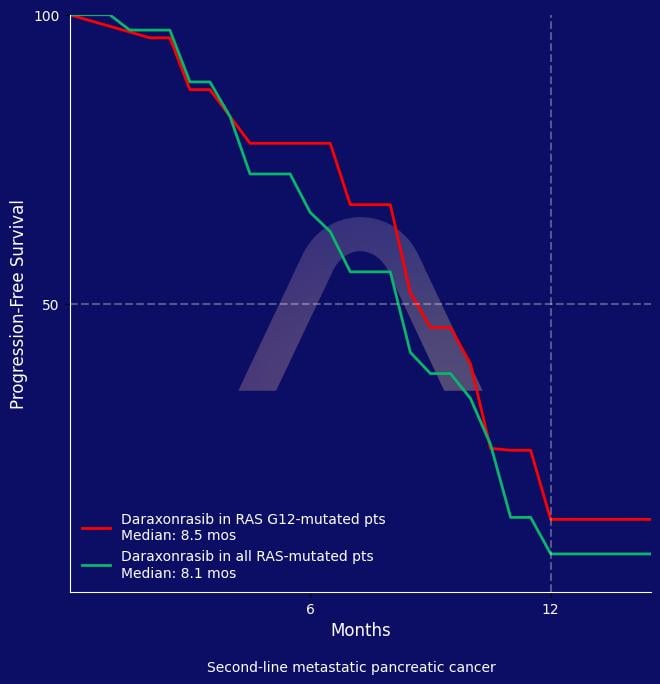
In this phase 1-2 study involving patients with previously treated RAS-mutated pancreatic ductal adenocarcinoma, daraxonrasib administered at up to 300 mg daily demonstrated antitumor activity with objective response rates of 35% in second-line therapy and manageable toxicity profile. Grade 3 or higher treatment-related adverse events occurred in about one-third of patients, primarily rash and anemia, but these were manageable without treatment discontinuation. The drug showed better efficacy and survival compared to historical second-line chemotherapy reports, supporting further evaluation in phase 3 trials.
Study
|
Phase 1-2 open-label multicenter study [RMC-6236-001] |
| Previously treated RAS-mutated pancreatic ductal adenocarcinoma (PDAC) |
| Daraxonrasib administered orally in doses up to 400 mg once daily; phase 3 dose selected as 300 mg
|
Efficacy
|
RAS G12-mutated 2nd-line therapy (300 mg): ORR 35% (17-56), median duration of response 8.2 mos (3.8-NE), mPFS 8.5 mos (6.7-10.5), mOS 13.1 mos (10.9-NE) |
| All RAS mutations 2nd-line therapy (300 mg): ORR 29% (15-46), median duration of response 8.2 mos (3.8-8.8), mPFS 8.1 mos (5.9-10.1), mOS 15.6 mos (10.9-NE). |
| Third- or later-line therapy (300 mg): RAS G12 ORR 21% (10-37), mPFS 4.3 mos (4.1-8.1), mOS 8.6 mos (6.4-11.9); all RAS ORR 20% (10-35), mPFS 4.3 mos (4.1-7.8), mOS 9.0 mos (6.7-11.1).
|
Safety
|
Grade >=3 treatment-related adverse events in 30% of patients overall; Rash (7% at 300 mg), anemia (7% at 300 mg), diarrhea (2% serious). |
| Dose modifications occurred in 48% at 300 mg due to AEs including rash and stomatitis/mucositis leading to dose interruptions (43%) and reductions (30%). |
| No discontinuations due to treatment-related adverse events at 300 mg.
|
N Engl J Med 2026;394:1790-802
http://doi.org/10.1056/NEJMoa2505783
Reviewed by Ulas D. Bayraktar, MD on May 15, 2026