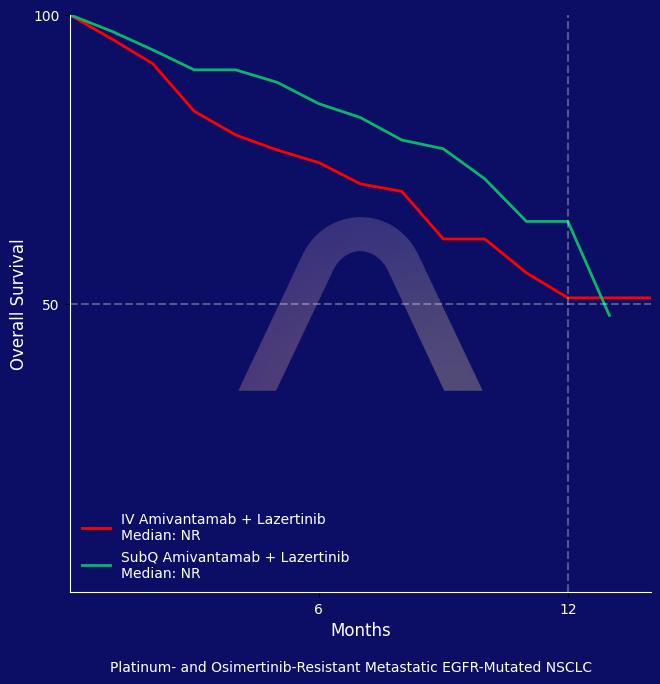
In the PALOMA-3 study, subcutaneous amivantamab-lazertinib showed noninferior efficacy to intravenous administration with improved safety and convenience. The subcutaneous route significantly reduced infusion-related reactions and demonstrated a superior overall survival. Subcutaneous administration also reduced venous thromboembolism rates.
Study
|
Randomized, open-label, phase III trial [PALOMA-3] |
| Patients with EGFR-mutated advanced NSCLC progressed after osimertinib and platinum-based chemotherapy |
| Subcutaneous amivantamab+lazertinib (n=206) vs Intravenous amivantamab+lazertinib (n=212)
|
Efficacy
|
ORR: 30% vs 33% (subQ vs. IV) (Non-inferior) |
| mPFS: 6.1 mos vs 4.3 mos |
| 12-mo OS: 65% vs. 51% (HR 0.62 [0.42-0.92])
|
Safety
|
Grade >=3 AE: dermatitis acneiform (9% vs 6%), lymphopenia (<1% vs 8%) |
| Infusion-related reactions: 13% vs 66% (subQ vs. IV) |
| Venous thromboembolism: 9% vs 14%
|
J Clin Oncol 2024;42:3593-3605
http://doi.org/10.1200/JCO.24.01001
Reviewed by Ulas D. Bayraktar, MD on Jan 18, 2026