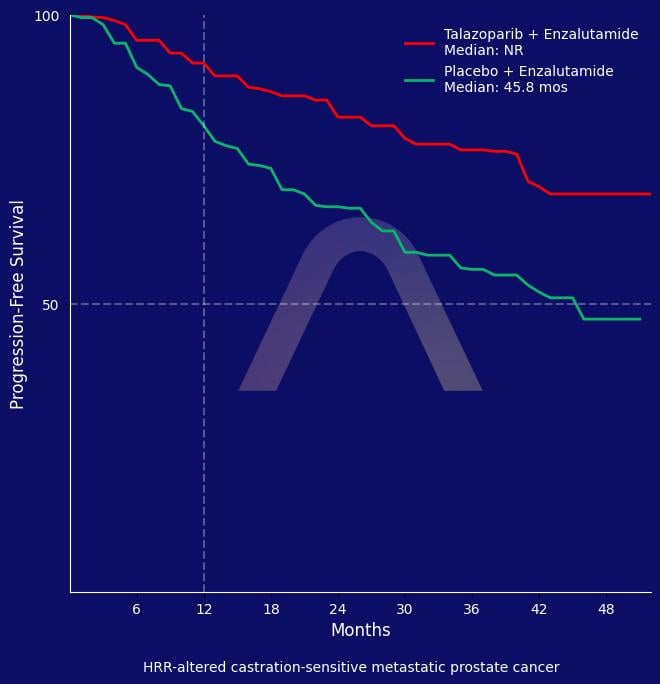
This phase 3 randomized trial demonstrated that talazoparib plus enzalutamide significantly improved imaging-based progression-free survival compared with placebo plus enzalutamide in patients with metastatic androgen pathway modulation-sensitive prostate cancer harboring homologous recombination repair gene alterations. Although overall survival benefit was not yet mature, talazoparib treatment was associated with increased hematologic toxicities, primarily anemia, which were manageable with dose modifications and supportive care.
Study
|
Phase 3, double-blind, randomized, placebo-controlled trial [TALAPRO-3] |
| Metastatic androgen pathway modulation-sensitive prostate cancer with homologous recombination repair gene alterations |
| Talazoparib plus enzalutamide (n=300) vs placebo plus enzalutamide (n=299)
|
Efficacy
|
Objective response in measurable disease: 75% vs 67% (talazoparib vs. placebo) |
| Imaging-based PFS at 3 years: 77% vs 56% (HR 0.48 [0.36-0.65]) |
| Median imaging-based PFS: Not calculable vs 45.8 mos |
| 3yr-OS: 78% vs 72% (HR 0.77 [0.56-1.04]) |
| No initiation of subsequent antineoplastic therapy at 3 years: 79% vs 62% (HR 0.51 [0.38-0.70])
|
Safety
|
Grade >=3 AEs: anemia (51% vs 3%), neutropenia (9% vs 1%), thrombocytopenia (5% vs 0%) |
| Serious AEs: 42% vs 32% |
| Treatment-related deaths: 1% vs 0% |
| Dose reductions: talazoparib or placebo 60% vs 7% |
| Discontinuations: talazoparib or placebo 19% vs 10%
|
N Engl J Med 2026; Published online May 30
http://doi.org/10.1056/NEJMoa2604126
Reviewed by Ulas D. Bayraktar, MD on Jun 15, 2026