

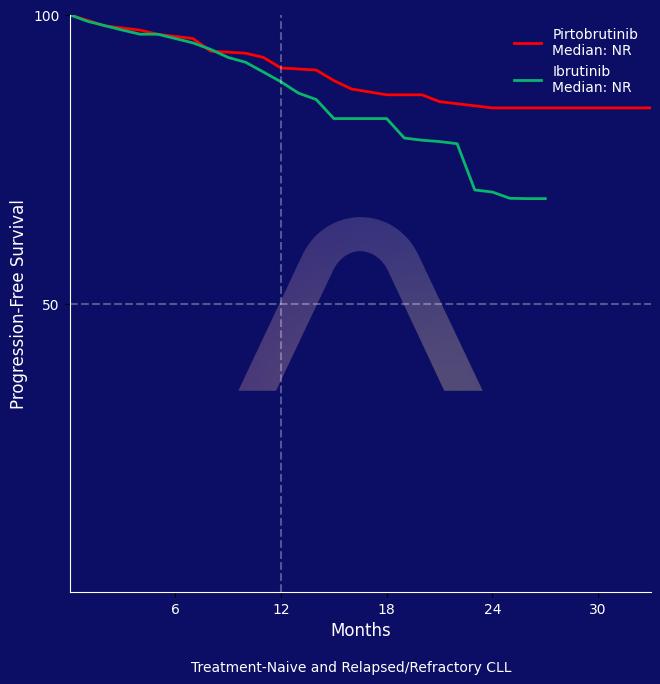
Pirtobrutinib was shown to be non-inferior to ibrutinib in terms of overall response rate and had a more favorable safety profile, with lower rates of adverse cardiac events. The study indicated that pirtobrutinib could be a preferable option, especially for treatment-naive patients, as it demonstrated better progression-free survival rates.
Study
|
Randomized, open-label, phase III study [BRUIN-CLL-314] Treatment-Naive(TN) or relapsed/refractory CLL/SLL |
| Pirtobrutinib (n=331) vs Ibrutinib (n=331)
|
Efficacy
|
ORR: 87% vs 78.5% (pirtobrutinib vs. ibrutinib) (p<0.001) |
| 18-mo PFS: 86.9% vs 82.3% (HR 0.57 [0.39-0.83]) |
| 18-mo PFS in TN: 95.3% vs 87.6% (HR 0.24 [0.10-0.59])
|
Safety
|
Grade >=3 AEs: atrial fibrillation (0.9% vs 4%), hypertension (3.3% vs 4.9%), neutropenia (25.3% vs 17.5%), thrombocytopenia (11.8% vs 17.5%) |
| Serious AEs: bleeding (3.3% vs 2.8%) |
| Treatment discontinuations due to AE (9.4% vs 10.8%)
|
J Clin Oncol. Published online December 7, 2025
http://doi.org/10.1200/JCO-25-02477
Reviewed by Ulas D. Bayraktar, MD on Jan 21, 2026


