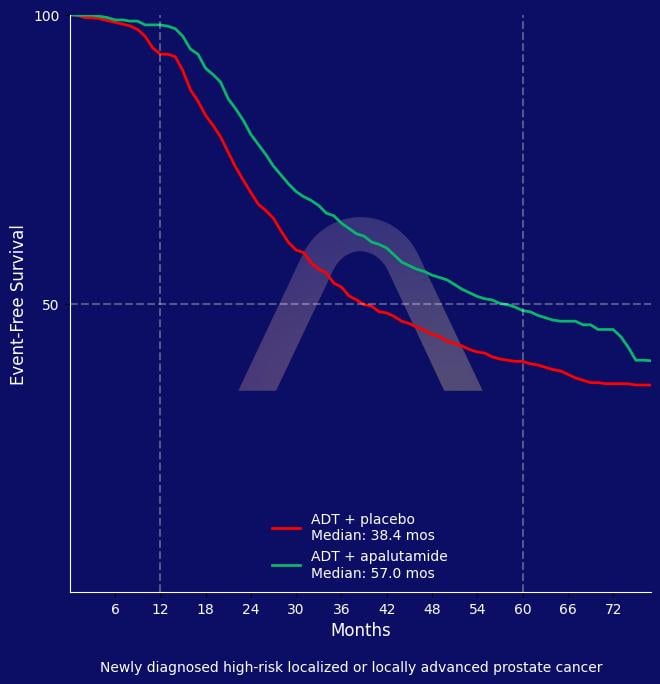
In this phase 3 trial in patients with high-risk localized or locally advanced prostate cancer, perioperative treatment with ADT plus apalutamide significantly improved pathological complete response or minimal residual disease rates and metastasis-free survival compared with ADT plus placebo. The apalutamide group also showed improved event-free survival, longer time to subsequent therapy, and higher freedom from disease at 4 years. Adverse events were more frequent with apalutamide, particularly rash, but the safety profile was consistent with previous studies.
Study
|
Phase 3, double-blind, placebo-controlled randomized trial [PROTEUS] |
| Newly diagnosed high-risk localized or locally advanced prostate cancer |
| ADT plus apalutamide (240 mg daily) (n=1057) vs ADT plus placebo (n=1052) for 6 cycles before and after radical prostatectomy with pelvic lymph-node dissection
|
Efficacy
|
pCR or minimal residual disease: 8.9% vs 1.0% (apalutamide vs. placebo) (OR 10.17 [5.27-19.64]) |
| Metastasis-free survival @ 5yrs: 78.2% vs 73.5% (HR 0.80 [0.67-0.96]) |
| mEFS: 57.1 mos vs 38.4 mos (HR 0.71 [0.63-0.80]) |
| Median time to first subsequent therapy: 74.2 mos vs 41.5 mos (HR 0.65 [0.57-0.73]) |
| Freedom from disease at 4 years: 21.9% vs 18.3% (OR 1.25 [1.01-1.55])
|
Safety
|
Grade 3 or 4 AEs: 39.6% vs 31.0% |
| Discontinuation due to adverse events: 7.4% vs 2.7% |
| Serious AEs: 19.3% vs 16.4% |
| Adverse events leading to death: 1.3% vs 0.5% |
| Most common AEs: hot flush (63.4% vs 56.5%), urinary incontinence (50.2% vs 50.9%), erectile dysfunction (41.6% vs 41.4%), fatigue (27.7% vs 26.8%), arthralgia (22.6% vs 19.4%), rash (21.2% vs 10.0%) |
| Venous thromboembolism: 2.0% vs 3.4% |
| Cardiac disorders: 6.8% vs 5.9%
|
N Engl J Med 2026; Published online May 31, 2026
Taplin ME, Gleave M, Shore ND Perioperative Apalutamide in High-Risk Localized Prostate Cancer
http://doi.org/10.1056/NEJMoa2603878
Reviewed by Ulas D. Bayraktar, MD on Jun 17, 2026