

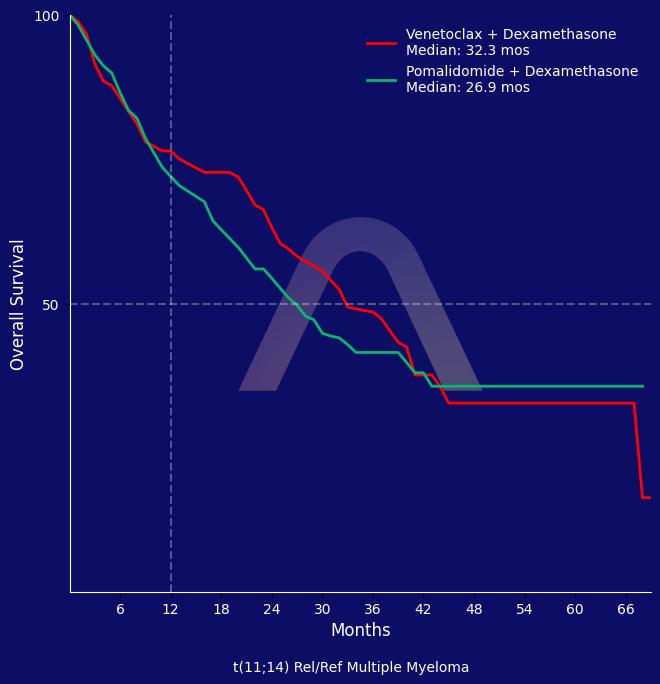
In the CANOVA study, venetoclax-dexamethasone did not significantly improve progression-free survival compared to pomalidomide-dexamethasone in patients with t(11;14)-positive relapsed/refractory multiple myeloma. However, overall response rate was higher in the venetoclax-dexamethasone group. Neutropenia was more common in the pomalidomide-dexamethasone arm.
Study
|
Randomized, open-label, phase III study [CANOVA; NCT03539744] |
| t(11;14)-positive relapsed/refractory multiple myeloma with >=2 previous therapies |
| Venetoclax-dexamethasone (n=133) vs pomalidomide-dexamethasone (n=130) until progression or toxicity
|
Efficacy
|
ORR: 62% vs 35% (venetoclax vs. pomalidomide) |
| Median PFS: 9.9 mos vs 5.8 mos (HR 0.823 [0.596-1.136]) |
| Median OS: 32.4 mos vs 26.9 mos (HR 0.856 [0.612-1.197]) |
| MRD negativity: 8% vs 0%
|
Safety
|
Grade >=3 AE: treatment-emergent adverse events (67% vs 83%), neutropenia (19% vs 54%) |
| Serious AEs: pneumonia (most common) |
| Treatment-emergent deaths: 12% vs 6%
|
J Clin Oncol 2025;44:164-175
http://doi.org/10.1200/JCO-25-00924
Reviewed by Ulas D. Bayraktar, MD on Jan 21, 2026


