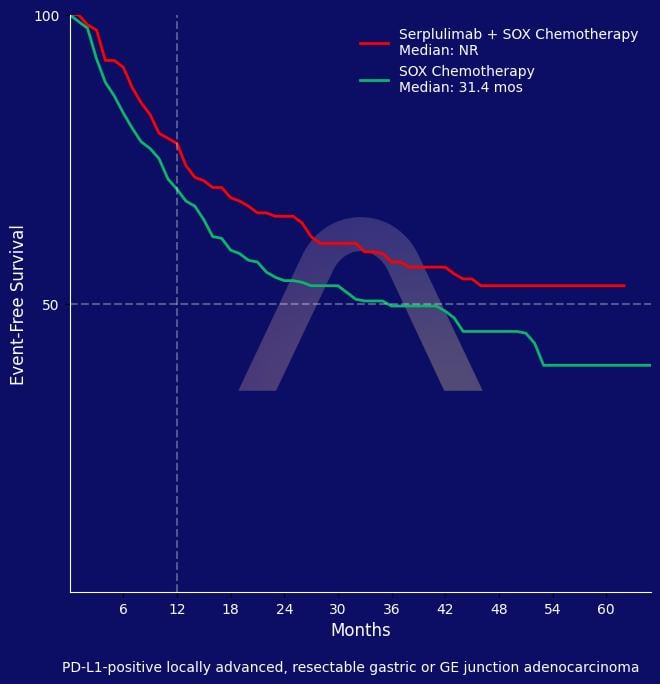
This phase 3 study demonstrated that neoadjuvant serplulimab plus chemotherapy followed by adjuvant serplulimab significantly improved event-free survival compared with perioperative chemotherapy alone in patients with PD-L1-positive, locally advanced, resectable gastric or gastro-oesophageal junction adenocarcinoma. The serplulimab regimen yielded higher pathological complete response rates and a favorable safety profile with lower rates of grade 3 or worse treatment-related adverse events and treatment discontinuations.
Study
|
Randomised, double-blind, multicentre, phase 3 study [ASTRUM-006] |
| PD-L1-positive (CPS >=5), locally advanced, resectable gastric or gastro-oesophageal junction adenocarcinoma |
| Neoadjuvant serplulimab (4.5 mg/kg IV) plus S-1 plus oxaliplatin (SOX) chemotherapy (n=292) vs placebo plus SOX (n=296), followed by adjuvant serplulimab (17 cycles) vs adjuvant SOX (5 cycles)
|
Efficacy
|
pCR: 26% vs 6% (PD-L1 CPS >=10), 22% vs 6% (intention-to-treat) |
| mEFS in PD-L1 CPS >=10 population: NR vs 42.0 mos (HR 0.65 [0.47-0.90]) |
| 3-year EFS: 61% vs 52% |
| mEFS in intention-to-treat population (CPS >=5): NR vs 35.9 mos (HR 0.73 [0.56-0.94]) |
| 3-year EFS: 57% vs 49% |
| R0 resection rate: 98% vs 98% (PD-L1 CPS >=10), 97% vs 97% (intention-to-treat)
|
Safety
|
Grade >=3 treatment-related AEs: 47% vs 59% |
| Treatment discontinuation due to AEs: 7% vs 11% |
| Immune-related AEs: 40% vs 6%, grade >=3: 6% vs 1% |
| Common grade >=3 treatment-related AEs: thrombocytopenia (17% vs 24%), neutropenia (9% vs 24%), anaemia (6% vs 9%)
|
Lancet 2026. Published online June 1, 2026
http://doi.org/10.1016/S0140-6736(26)00974-8
Reviewed by Ulas D. Bayraktar, MD on Jun 17, 2026