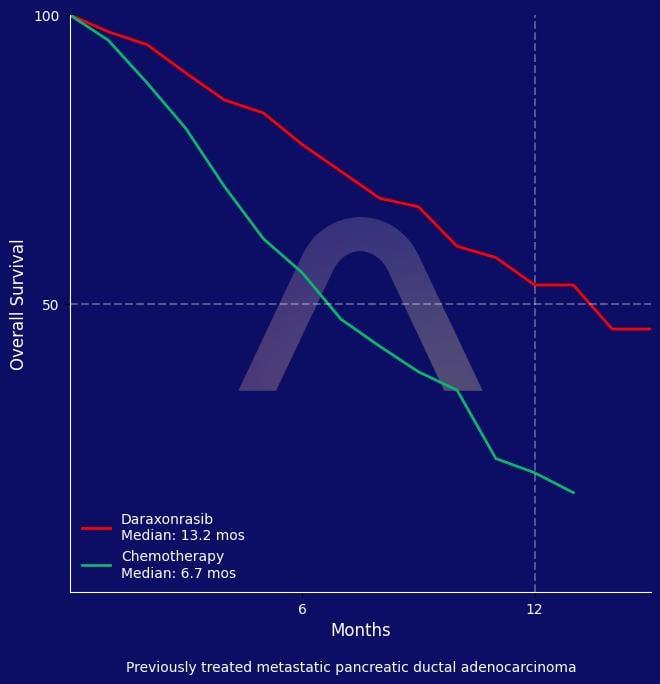
In this phase 3 randomized trial in patients with previously treated metastatic pancreatic ductal adenocarcinoma, treatment with daraxonrasib significantly improved overall survival and progression-free survival compared to investigator’s choice chemotherapy. The response rate was higher with daraxonrasib, and patients reported longer times to deterioration in pain and quality of life. Daraxonrasib treatment was associated with fewer grade 3 or higher adverse events, fewer treatment discontinuations, and a generally manageable safety profile.
Study
|
Phase 3, international, open-label, randomized trial [RASolute 302] |
| Previously treated metastatic pancreatic ductal adenocarcinoma |
| Daraxonrasib (n=248) vs chemotherapy of investigator’s choice (gemcitabine plus nab-paclitaxel, liposomal irinotecan plus fluorouracil and leucovorin, modified FOLFIRINOX, FOLFOX) (n=252)
|
Efficacy
|
ORR: 33% vs 12% (daraxonrasib vs. chemotherapy) |
| mOS in RAS G12 population: 13.2 mos vs 6.6 mos (HR 0.40 [0.30-0.54]) |
| mOS overall population: 13.2 mos vs 6.7 mos (HR 0.40 [0.30-0.53]) |
| mPFS in RAS G12 population: 7.3 mos vs 3.5 mos (HR 0.45 [0.34-0.59]) |
| mPFS overall population: 7.2 mos vs 3.6 mos (HR 0.49 [0.38-0.64])
|
Safety
|
Grade>=3 treatment-related AE: rash (14% vs 0%), stomatitis (12% vs 3%), neutropenia (2% vs 28%), anemia (4% vs 16%), diarrhea (5% vs 7%), fatigue (4% vs 6%) |
| Serious TRAE: 11% vs 19% |
| Treatment-related AE leading to discontinuation: 1% vs 11%
|
N Engl J Med 2026;394:1790-1802
http://doi.org/10.1056/NEJMoa2605555
Reviewed by Ulas D. Bayraktar, MD on Jun 17, 2026